A man of serendipitous luck, Michael J. Wilson’s third year of teaching at SFUAD also marks the publication of his first poetry collection A Child Of Storm. Born in England, Wilson spent his childhood moving from place to place. Along with his time at the New School in New York City, these experiences shaped the poems that would eventually constitute his first book, solidifying an already-present fascination with the life of Nikola Tesla and shifting his focus to the way people relate to each other. With only days left until the book release, Wilson spoke with Jackalope Magazine about his writing process and the themes of his poetry.
Author: mgdoherty
A Fresh Angle and All That
A Corner of White by Jaclyn Moriarty
My rating: 5 of 5 stars
SPOILERS AHEAD. And now that you’ve been warned, on with the review! So, as a YA fiction enthusiast who is also tired of tropes, this is the fantasy book I’ve been waiting for. There has never been a book I’ve more wanted on my bookshelf. There was such an original plot. It was so beautifully written. Everyone in this book lives in a dream world, dreaming that they’re Lord Byron or Isaac Newton and dreaming about colours and Colors and missing fathers and swan-mothers. Some lines I love:
“When Jack cast his gaze over Madeleine’s former life he caught glimpses of sails swelling in gusts of winds, reindeer stamping and breathing mist, diamonds woven through plaits and spilling like raindrops down a window.”
“Jack had gathered the names together by the stems; he’d arranged them in a vase that he kept to the right of his mind. At night, before he fell asleep, he’d breathe in the fragrance of each, the details that Madeleine had shared.”
“a whole bubbling brook sort of name”
“What hinders the fixt stars from falling upon one another?… She had to stop the stars from tumbling together… A sky full of stars was relying on her to keep her back straight, her shoulders firm, her head nodding now and then, her voice calm and polite… because as long as she did that, her mother would be okay… All she had to do was keep the stars fixed to the sky.”
“The thing is, Elliott, you were like a piece of magic. You held the fixed stars in place for me and you stopped them from falling. If I open another letter from you, I think they might start to tumble.”
There is this really clever extended metaphor revolving around Isaac Newton, Lord Byron, and Ada Lovelace, and how their lives parallel the lives of Madeleine, Jack, and Belle. What starts out as an annoying school assignment becomes this heartbreaking condemnation when Madeleine starts recognizing the cracks in her own worldview, realizing that her father is not some glittery hero and her mother is not a lost swan in a tower.
I also really appreciate how the romance was handled in here, mostly Madeleine and Jack’s relationship. In general, I am not a fan of romance in YA novels because nothing feels original anymore, nor does it ever feel realistic, or it will takes over the actual plot. What made this feel fresh was how both Madeleine and Jack both accepted that they worked better as friends at the end of the book. The power of Madeleine’s journey is that once she “wakes up,” she sees that Jack is remarkable just as he is, a teenage boy in Cambridge, her friend. Elliott and Kala’s relationship was tolerable for me. It felt very sentimental at times, but the burst of clarity from Elliot’s perspective injected some much-needed realism into their relationship. Elliott realizes that his feelings for Kala don’t make either of them as wonderful or perfect as they see each other; or else, how could he have cheated on her? It seemed a healthier alternative to seeing each other as perfect.
Language as Agency
Within Alexis Hall, the tutors of the Writing Center live out a parallel reality. While they are providing invaluable assistance in writing, art history and math, they also are engaged in a mission of their own—one that aims to empower students and allow them to speak confidently about their art.
Revelry Night
As the first welcome party designed to introduce students to others in their program, Sept. 13 marked a change in the Creative Writing and Literature department’s usual welcome routine. Rather than hosting a reading by returning students, writers instead engaged in rapid-fire speed chat to introduce themselves, competed fiercely in games of Taboo, mingled over cake and jumped in a character-building exercise.
Read about the Creative Writing and Literature department’s welcome party at Jackalope Magazine.
SWA Welcomes Writers Back
Every Tuesday night in a cozy Alexis Hall lounge, members of the Student Writers Association gather to de-stress, improve their craft, and forge new friendships. SWA is the Creative Writing department’s flagship club, led by officers Amaya Hoke, Andrew Koss, Charlotte Renken, and Kylie Yockey. Though it’s commonly thought that writers choose to work in isolation, SWA aims to break that mold of thinking.
Read about SWA’s goals for the new year at Jackalope Magazine.
“Flipper-Footing”
The Brides of Rollrock Island by Margo Lanagan
My rating: 4 of 5 stars
Low-key spoilers ahead. You have been warned.
After a few recent disappointments, it was so refreshing to read a book like this. The language was so lovely and I adore how new words are constructed. Listen to this — “when they had found flipper-footing they began to gallop toward me, as sheep hurry over their snowy field to a fresh-dropped hay bale, or pigs cross a sty at the clink of a slop bucket.” Flipper-footing. I have a new favourite word.
I had before never ventured into the realm of selkie fantasy fiction, but I’m glad to start here. Lanagan really captured the silent heartbreak of tearing these seal-women from the sea, the injustice and the cruelty of it. Frankly, by the end of this book, I would’ve quite happy to stand around with Miskaella and Trudle and watch the men stay miserable. Having stolen wives for at least two generations (my math is probably not up to snuff), I thought they deserved all the misery they got. But maybe I’m just being very uncharitable.
The book certainly did a good job of illustrating what an unhealthy love looks like, because none of these marriages, save that of Dominick’s mam and dad, were healthy. Misskaella enchanted the men and trapped the women; the men could not look beyond themselves enough to set their wives free; the seal-women loved their husbands but loved the sea more.
The seal-wives were extremely docile for much of the book; stealing their skins seemed to sap them of the spirit to protest their circumstances. That was frustrating, especially since only Daniel seemed to have the guts to release them. However, the seal-women found strength enough to do what was needed to escape and protect their children.
I also appreciate the glimmer of hope there at the end, with Lory and Daniel’s second meeting, him smiling. While slightly contrived, it was refreshing, like two souls breaking out of the shadows of the last generation. And Trudle… I didn’t expect to ever like her, but the final chapter from her perspective was so moving. I was happy that she was content as the island revived around her, that she discovered the last of Misskaella’s secrets.
All in all, a lovely read and one I’m proud to have on my bookshelf.
Elegy Made Manifest – an interview
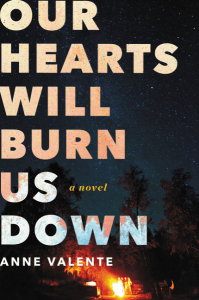
With the close of September, Anne Valente’s debut novel Our Hearts Will Burn Us Downapproaches its release date. A local school shooting leaves a St. Louis community reeling, especially high school juniors Matt, Zola, Nick, and Christina. The four main characters struggle to piece their lives back together and make sense of the tragedy while a series of fires continues to ravage the homes of victims’ families. Ultimately the story within is a stunning tale of the all-consuming nature of grief and the permanence of loss, in and of itself a statement about a society where mass violence is increasingly common.
A Gem on my Bookshelf
The Accident Season by Moïra Fowley-Doyle
My rating: 5 of 5 stars
SPOILERS AHEAD. Okay, now you’ve been warned. This book was beautifully written. As another reviewer pointed out, the magical realism and even the prose reminded me of Nova Ren Suma, particularly her Imaginary Girls. The language was so lovely, so much like poetry. From a craft standpoint, I loved the construction of some of these sentences — the repetition, the way certain sentences fall like stones in a pond, the cold delivery of magical lines. Some stand-out lines:
“Alice wasn’t the first to jump, but she was the first to fall. It started with dares. Dare you to roll down the hill. Dare you to touch a nettle. Dare you to jump across the stream.”
“So let’s raise our glasses to the accident season, / to the river beneath us where we sink our souls, / to the bruises and secrets, to the ghosts in the ceiling, / one more drink for the watery road.”
“His mask is askew. Nick’s wolf face is on the ground in front of me. Its eyes are empty sockets. It has no mouth but it is still whispering: if you’re going to do this just give me one last chance you know you want to come on if you really want to end it you owe it to me just give me one last—”
“I am wet to the skin, I am shivering and my wings are shaking. I am cold stone behind my mask. I might not be human at all.”
“I remember a slap across my cheek in a hallway; I remember hands on my shoulders pushing me down, keeping me underwater; I remember being told to forget.”
This book perfectly straddled the line between our reality and magical realism. The accident season was the overwhelming shadow that hung over the entire book, but as you read, you start to get the sense that the accident season is an illusion that Cara’s family believes so that they don’t have to face the truth. Slowly over the course of the book, it becomes clear that something awful happened in their family, and no one can talk about it. The metal man with the evil smirk and Cara’s memories of almost drowning and being slapped as a child and Alice being “bundled up warmer than October every summer, afraid of showing her body.”
Cara’s blindness plays out in a similar way. At the start of the book, there’s the sense that she’s not seeing the world for all his ugliness, that she can’t face it, and it hits like a hammer when you realize she doesn’t see, doesn’t remember the ugliness of her childhood because her sister’s abuser told her to forget or he’d hurt her, and what else can a child do but forget when faced with an adult trying to drown them. When Cara starts to see, the horrible puzzle pieces start to come together, how Nick is hitting Alice and she takes it because she’s been miserable for so long, she doesn’t know any other way to live, she stays with him because at least this is the pain she chooses rather than the pain someone more powerful inflicted on her as a child.
“I laugh at the accident season, at the accident of Alice hitting her head on Nick’s mantelpiece, at the accident of the bruises on her legs, at the accident of the cuts on her arms. I laugh at the accident of the broken glass a few years ago that somehow managed to slice her wrist in a perfectly straight line. I laugh at the accident of Sam punching the wall in the secrets room. I laugh at the accident of the day I almost drowned. I laugh at the accident of my uncle’s death. Seth knew too, I think. That’s why he pushed him in… I stop laughing.”
I don’t know what else I can say. This book is a trip, but every heart-wrenching moment came together perfectly. The fact that not everything can be explained away at the end was lovely. The mystery of Elsie, their little guardian angel. The magical costume shop and the ghost house that listens to Cara’s wishes.
Just read it.